
I keep a lined journal on the kitchen table and put a small doodle in the corner of most pages. Here are the nine styles I draw over and over, the ones worth drawing again.
How I Chose These “Best” Journal Doodles
I’m Colleen, a hobbyist at Page Corner Doodles who puts a small doodle in the corner of most journal pages, and these are the ones worth drawing again.
By “best” I mean: quick to draw, forgiving when lines wobble, easy to repeat across a whole notebook, and friendly to thin journal paper. My own limit is about two inches square and under two minutes. I left out complicated illustration-style doodles. Instead I checked how each style handles corners, borders, banners, mistakes and bleed-through. Basic doodles require minimal tools like pens and paper, so nothing here needs a special kit. If you want a quick run through the essentials, see my basic doodle art supplies.
One aside I enjoy: the Wikipedia entry on doodles notes the word once meant a fool or simpleton. A tiny corner doodle is one of the more sensible things I do all day.
Top 9 Bullet Journal Doodle Styles I Use Over and Over
This is the heart of the article and answers “what should I doodle?” fast. Each style gets why I like it, who it suits, strengths and limits.
1. Tiny Leaf Corners
One curved stem with pairs of pointed-oval leaves, tucked into a corner or beside a date. My leaf sprig is the first drawing I’d hand a beginner. It looks elegant when drawn fast and hides wobbles because real leaves are uneven anyway. Beginner doodles often include flowers and leaves for exactly this reason. Doodles can be simple shapes like hearts and stars, but a leaf sprig feels a step more personal. If you are new to drawing, consider starting with cute doodles before the leaf sprig.
Scales from a corner curl to a cluster around a header. Three sprigs in a row make a tiny border. Gets samey if it’s the only doodle you draw, and extra-fine nibs can look scratchy on toothy paper.
2. Simple Line Borders
Double or dashed lines around a box or page, sometimes with dots on the corners. Makes a list or log feel finished with no artistic skill. Draw with a ruler or freehand. Borders and frames are popular doodle ideas for journals because they act as visual anchors that help structure and organize journal pages.
Fits any size, pairs with corner doodles, works with nearly any pen. Ruler pressure creeps in if you want to stay loose. Layered lines can shadow through thin paper.
3. Ribbon Banners for Titles
Folded ribbon shapes behind words like “January” or “To Do.” Turns plain handwriting into a header, built from simple rectangles. Doodle banners can add flair to journal pages, and they look bold without calligraphy. Best for themed monthly spreads and titles that must stand out in a busy page.
Any size, outlined or colored, and good practice for overlapping lines. Leave room for the folded ends. Juicy brush pens can feather in tight corners on rougher paper.
4. Tiny Weather and Mood Icons
Suns, clouds, raindrops, stars and simple faces beside dates or trackers. My cloud with raindrops (a small sun if the day was sunny) and my crescent moon with three or four stars live here. Weather and mood icons can be incorporated into journaling for daily tracking, and they serve as visual shorthand to document experiences or memories.
Seconds per day, tolerant of uneven circles. Odd numbers of stars look more natural. Thick markers blur small icons, and drawing the same sign daily gets dull after a few weeks.
5. Boxed Habit Trackers with Simple Embellishments
Habit grids decorated with dots, arrows or mini corner doodles. Adds just enough decoration to a functional page and practices tiny repeated motifs. Common types of journal doodles include functional icons and organizational elements like these. Doodling can improve self-reflection by revealing mood patterns and interests when you look back at a filled tracker.
Mostly straight lines, pen-only decoration, adjustable to any month. Crowded if every box is decorated. Freehand grids are tedious, so a ruler or dot-grid helps.
6. Floral Page Corners and Side Sprigs
Five-petal flowers, buds and stems along an edge. My flower in a jar, with mixed heights and a different bloom on each stem, is the version I draw most. Satisfying even when unrealistic, and curves loosen your hand after lists. Quick sketches like these can capture memories and enhance recall of written notes. Use colored pens to enhance doodle vibrancy if you have them.
Seasonal swaps work well (buds for spring, bare branches for winter). Fine as a border or one corner accent, fine in monochrome. Solid-filled petals ghost on thin paper. Too decorative for finance pages.
7. Simple Geometric Frames
Rectangles, circles and hexagons around quotes or lists. Clean and modern, easy with dot-grid guides. Repeating one shape makes a spread cohesive. Doodles drawn around or alongside written entries enhance visual interest, and geometric frames do that with almost no effort.
Pairs with plain print handwriting, any line weight, highlighter behind the shape. Symmetry is hard without a ruler. Overlaps show through the page.
8. Little Themed Icons for Monthly Pages
Small objects matched to the month. My steaming mug, mushroom, stack of books and paper airplane (for trips and plans) fit this. Month headers can be creatively doodled in journals with a single repeated icon. Common journaling themes for doodles include gratitude, daily highlights and moods, so matching an icon to a theme gives each month its own feel.
One icon per month keeps decisions simple. Scatter it in corners, headers or trackers. A new icon each month stays small enough for bleed-prone paper, and repetition builds line confidence. Fine-line icons like snowflakes fuzz on cheap paper. Not for neutral-journal fans.
9. Quick Pattern Fillers
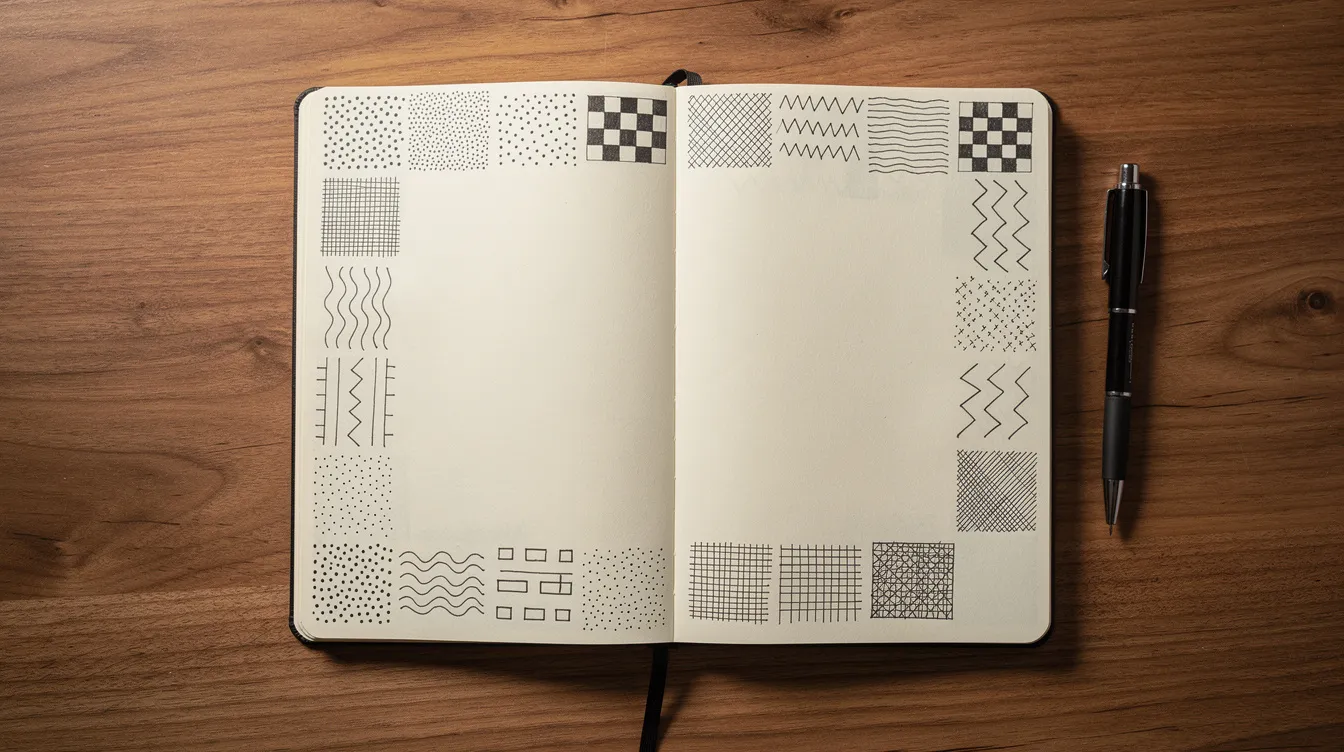
Stripes, checkerboards, waves and dots for empty boxes or margins. Ideal for podcasts and long calls, and they cover small mistakes. Adding doodles like these reduces stress and encourages relaxation during journaling. Doodles also help break through writer’s block by providing a low-pressure creative outlet when you can’t think of what to write.
Tiny or full-page, mono or two-color, and good practice for pressure and spacing. Dense hatching bleeds, especially with gel pens on paper under 80 gsm. Too busy on already decorated pages.
Quick Comparison of These Bullet Journal Doodle Styles
A scan-friendly guide by mood or use:
-
Tiny Leaf Corners: soft accents for daily logs.
-
Simple Line Borders: neat lists in seconds.
-
Ribbon Banners: bold monthly titles.
-
Weather & Mood Icons: quick daily visual notes.
-
Boxed Habit Trackers: functional but a bit decorative.
-
Floral Corners & Sprigs: cozy gratitude and reading pages.
-
Geometric Frames: minimalist layouts and quote boxes.
-
Themed Monthly Icons: simple monthly themes.
-
Pattern Fillers: covering blank space while relaxing.
How to Choose the Right Bullet Journal Doodles for Your Pages
The right doodle depends on your paper, pens, time and tolerance for mistakes. My rule: pick one corner before writing, bottom right for me so my hand never smudges it.
Choose Based on Your Paper and Pens
Thin 80 to 90 gsm paper favors light lines over solid fills. I use a black 0.3 or 0.5 fineliner, a brush pen for accents, and pencil and eraser for layout. Fineliner pens are ideal for detailed doodles. Brush pens allow for varied line thickness. Gel pens provide smooth ink flow for doodling, and permanent markers are great for bold doodle outlines on heavier stock.
Test any new pen on the last page of the notebook. Fineliners behave on most paper, while markers and brush pens bleed more. Watercolor pencils can add soft color to doodles without the bleed risk of wet ink. Markers provide bold colors for doodle designs but need thicker paper. Layering colors creates depth in doodles when your paper can handle it.
Choose Based on How Much Time You Really Have
Short on time: icons, leaf corners, borders. Trackers and pattern fillers suit a longer sit. Mix both across the week. Doodling enhances the overall experience of journaling, making it more interactive even on busy days.
Choose Based on How Nervous You Feel About Mistakes
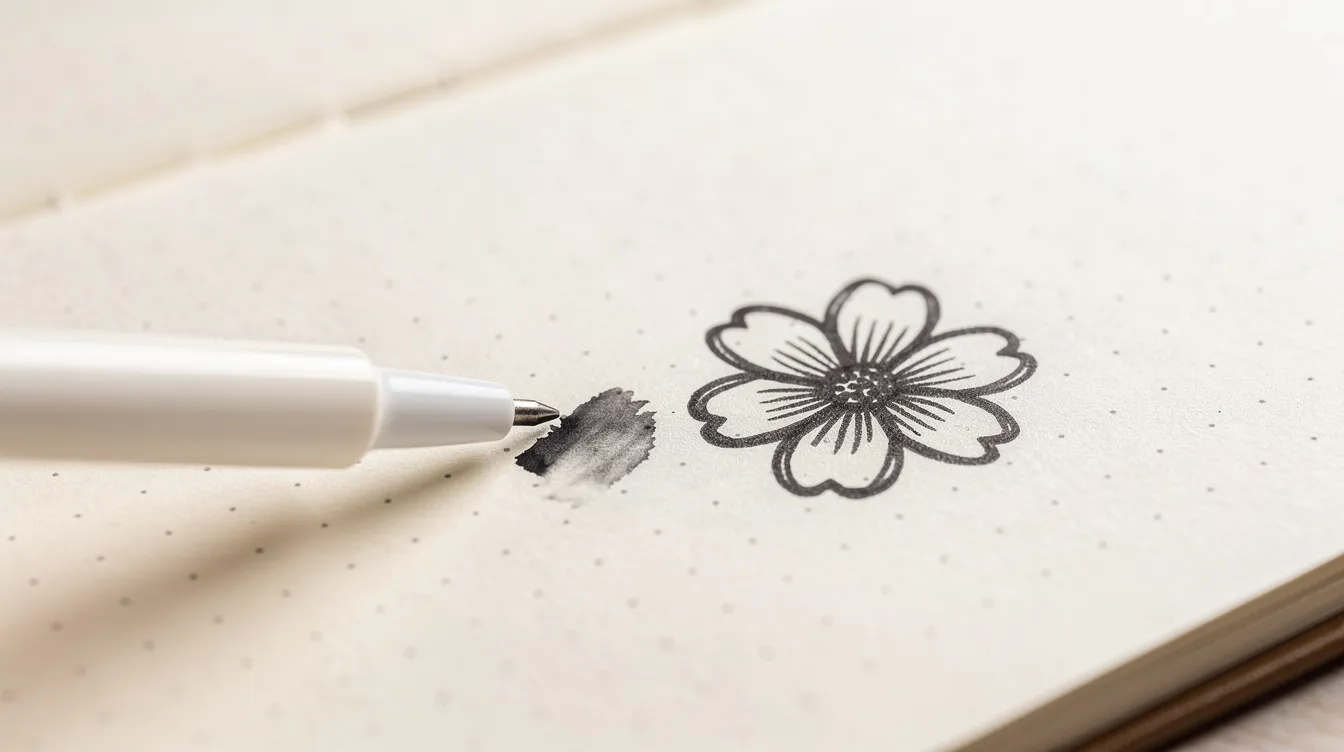
Leaves, florals and patterns hide shaky lines. Sketch lightly in pencil first, ink over it, wait a minute, then erase. Try frames and banners once you are comfortable with guide lines. Use white gel pens to cover small doodle mistakes on dark patches. Incorporate mistakes into new doodles creatively: an ink blob becomes a fuller flower, a smudge disappears under a pattern filler. For bigger problems, cut out mistakes and glue new paper over them.
Doodles can express thoughts, feelings and experiences creatively in journaling, so a “mistake” that turns into something new is part of the process.
Which Bullet Journal Doodles Might Suit You Best?
People journal to plan, remember or think quietly, so the best doodle depends on why you write. Using doodles can make journaling more fun and engaging for casual journalers, and they make journal entries visually appealing and personal.
-
Choose Tiny Leaf Corners for calm pages with no planning.
-
Choose Simple Line Borders for tidy lists in a bullet journal.
-
Choose Ribbon Banners for bold headers on collection pages.
-
Choose Weather & Mood Icons for quick daily repeats. I match mine to the entry: mug for morning pages, moon for evenings.
-
Choose Pattern Fillers for zoning out and rescuing awkward gaps.
If you search online for new ideas, autocomplete results are available before you finish typing. On a phone, touch device users explore by touch or with swipe gestures. On a keyboard, use arrows to review and enter to select from the list. A quick search for “bullet journal doodle” or “bujo doodle ideas” will continue to turn up results are available use to anyone with an email and a free account; many sites let you continue with Google as well.
Final Thoughts
Journal doodles needn’t be elaborate to satisfy. These are simply the ones I use most: easy, small and repeatable.
Pick one or two for your next spread. Keep one line weight, one ink color and a similar size so a page of doodles looks like a set. Keep a thumbnail list at the back of the journal so you remember what you have tried. Adapt them to your own handwriting, paper and pens so the pages look like yours, not mine.
FAQ
What is the easiest journal doodle for a total beginner?
A leaf sprig: one curved line with pairs of pointed ovals. Wobbles look natural, and it takes under thirty seconds. For more starter ideas, read my easy journal drawing ideas.
How big should a corner doodle be?
About two inches across: recognizable, with room left for your writing.
Do I need special pens for journal doodles?
No, any pen that does not smear works. I like a 0.3 or 0.5 black fineliner, but a ballpoint is fine for practice.
How do I stop my doodles from looking messy?
Sketch lightly in pencil, keep shapes simple, and use the same pen every time. Consistency does more than skill.